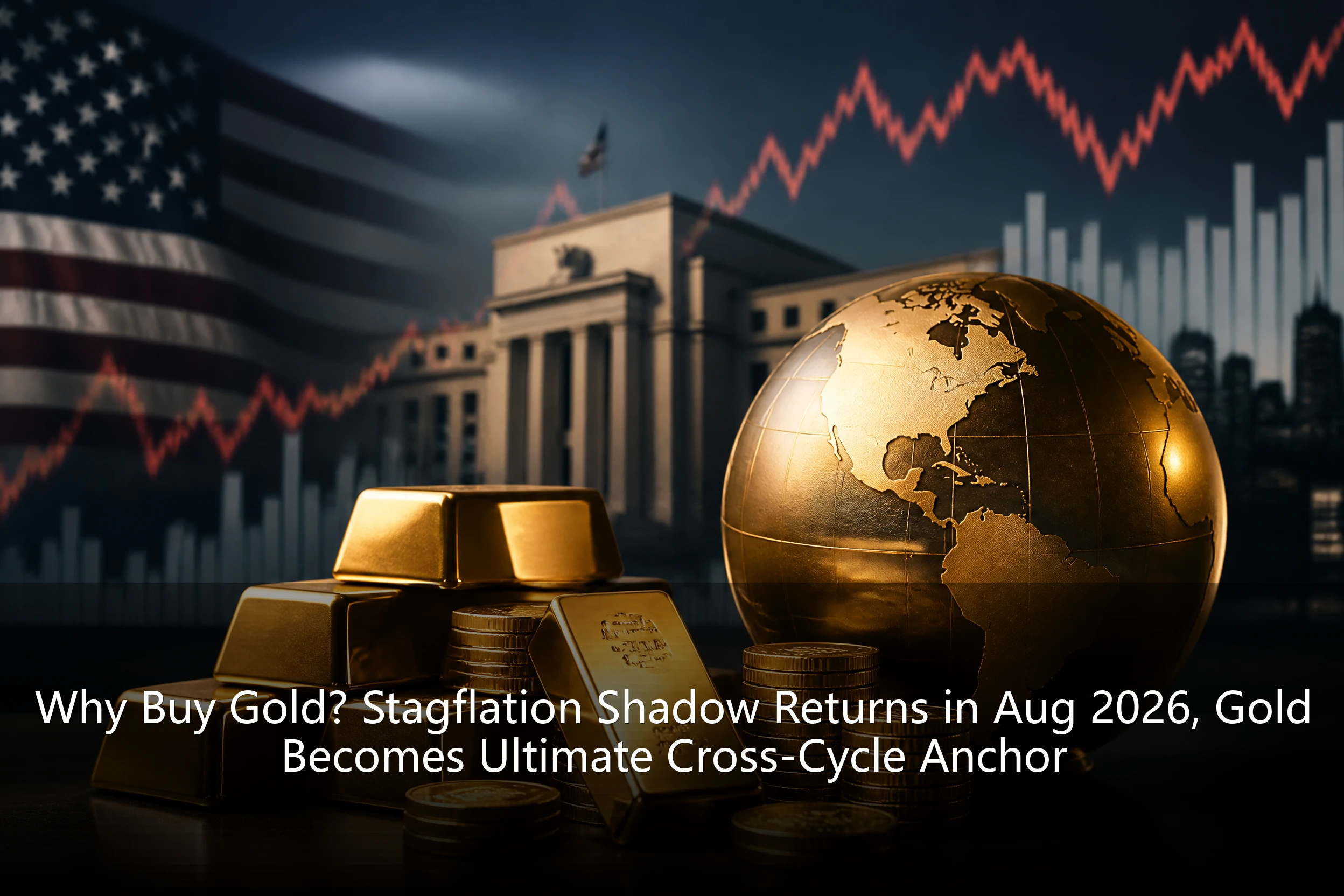
Introduction: The Stagflation Shadow of Midsummer 2026, Why the "Buy Gold Consensus" is Awakened Again
Entering August 2026, the US macroeconomy is stepping into an extremely sensitive and complex stage. Although the Fed tried to balance inflation and economic growth through subtle interest rate policies in the past few quarters, the latest series of economic data made the market smell a dangerous "stagflation" breath. On one hand, the decline in core inflation has stalled, with even signs of local rebound, and living cost pressures continue to plague US families; on the other hand, the marginal weakening of manufacturing prosperity and the job market suggests that the high-speed growth engine of the US economy is cooling down.
Against this macro backdrop, the high-level volatility of US stocks and the drastic fluctuations in US Treasury yields make traditional asset allocation portfolios face huge uncertainty. For investors, an old yet extremely realistic question is posed again: why buy gold? The gold market in 2026 is no longer just a simple game of commodity supply and demand, but has evolved into the ultimate anchor for global capital to hedge fiat credit risks and cross economic cycles. This article will combine current US economic fundamentals and precious metal market dynamics to deeply analyze the irreplaceable strategic allocation value of gold in the current environment.
I. The Rekindling of Stagflation Risk: The "Failure" of Traditional Financial Assets and Gold's Breakthrough
1. Sticky Inflation and Slowing Economic Growth
Looking back at the US economic trajectory in the first half of 2026, the "soft landing" expectation is being gradually falsified by cruel data. The manufacturing and services PMI data released in early August diverged, especially the unexpected dive in services, shattering the market's illusion of steady economic expansion. Meanwhile, although the Fed maintains a restrictive interest rate level, services inflation is extremely sticky, with housing and medical costs remaining stubbornly high. These typical pre-stagflation characteristics of "high inflation accompanied by low growth" deal a double blow to traditional financial assets.
In a stagflation environment, corporate profits are squeezed by both rising costs and shrinking demand, shaking the valuation foundation of US stocks. At the same time, high inflation means the Fed cannot easily start a massive rate-cutting cycle, making it hard for real yields on Treasuries to fall effectively, putting pressure on long-term Treasury prices. When stocks and bonds, the two cornerstones of traditional asset allocation, perform weakly at the same time, investors must find assets that are independent of the economic cycle and not backed by any government credit, making gold the key to a breakthrough.
2. Fiat Credit Hedging: Why Gold is the "Mirror" of the Fiat System
The essence of gold is a measure of value recognized by human society for thousands of years, independent of the rise and fall of any state regime. Under the fiat monetary system, when central banks constantly expand their balance sheets to stimulate the economy, the purchasing power of fiat currency is inevitably diluted. In 2026, the massive US fiscal deficit remains unresolved; although the debt ceiling issue was postponed through temporary legislation, the shadow of the "fiscal cliff" always looms over the dollar system.
Why buy gold? Because gold is a hedging tool for dollar credit. When the market doubts the long-term purchasing power of the dollar, gold's pricing logic will return from a substitute for interest-bearing assets to pure credit hedging and preservation. In 2026, driven by both inflation rebound and geopolitical risks, gold is not only a tool to hedge against dollar depreciation, but also a financial firewall protecting family wealth from being swallowed by hidden inflation.
II. The Fed's Policy "Dilemma": The Game Between Rate Cut Expectations and High Interest Rates
1. The Fed's Predicament and the Repricing of Gold
The Fed's policy trend is always the core variable affecting precious metal pricing. In August 2026, the Fed is in an awkward "dilemma": if it cuts rates early to deal with the economic slowdown, it may trigger a second loss of control in inflation expectations, leading to a steepening of the Treasury yield curve and a weaker dollar index; if it maintains high rates to suppress inflation, it may trigger a corporate debt crisis and consumption recession, which would also weaken the appeal of dollar assets.
This policy dilemma actually creates an excellent macro hotbed for gold. From historical experience, gold often performs most brilliantly at the end of the Fed's rate-hike cycle and the beginning of the rate-cut cycle. Because once economic data weakens consecutively, the market will hype rate cut expectations in advance, leading to a decline in real rates, thereby greatly reducing the opportunity cost of holding gold. The current gold price stabilizing at a high level around the $2,800 mark is exactly the market preparing for the future rate-cutting cycle.
2. Dual Resonance of Anti-Inflation and Safe-Haven Attributes
In traditional investment theory, a high-interest-rate environment usually suppresses non-yielding gold. However, why does the gold price in 2026 still maintain extremely strong resilience despite the Fed not officially cutting rates? The reason is that gold's safe-haven attribute and anti-inflation attribute are experiencing a dual resonance.
When inflation remains consistently above the Fed's 2% target, gold, as a physical asset, sees its intrinsic value naturally rise with the price level, exerting an excellent anti-inflation function. Meanwhile, geopolitical uncertainty, policy volatility expectations from the US election, and global supply chain reconstruction are constantly injecting safe-haven sentiment into the market. Under the overlap of multiple premiums, gold's sensitivity to real rates has decreased, forming a strong trend independent of the traditional rate pricing model.
III. Tight Physical Supply and Demand: Global Central Banks and ETFs Resonate to Push Up Gold Allocation Wave
1. Continuous Accumulation by Global Central Banks: Strategic Choice Under De-dollarization
In recent years, the gold-buying frenzy of global central banks has become an important force reshaping the gold supply and demand landscape, and this trend remains unabated in 2026. According to industry data, emerging market central banks are buying gold at a record pace to reduce reliance on single-dollar assets and optimize foreign exchange reserve structures. This state-level strategic buying builds a solid bottom support for gold prices.
The massive gold purchases by central banks send a clear signal to the market: gold's status in the global monetary system is being redefined. For ordinary investors, following the pace of central banks in asset allocation is undoubtedly an effective strategy to reduce macro risks. This is also the fundamental reason why, in the current complex economic environment, more and more institutional investors are loudly advocating "why buy gold".
2. Gold ETF Holdings Reflow: The Reawakening of Western Capital
If central bank gold purchases are the "ballast" of the gold market, then changes in gold ETF holdings are the "barometer" of Western investment sentiment. After experiencing volatile outflows in the previous two years, in August 2026, gold ETFs in North American and European markets began to show continuous net capital inflows. This change is of great significance, indicating that Western capital is re-examining gold's weight in asset allocation portfolios.
With the intensifying volatility of US stocks, institutional investors must introduce assets with extremely low correlation to the stock market to mitigate the drawdown risk of investment portfolios. The record-breaking rebound in gold ETF holdings not only provides incremental funds for gold prices to break historical highs, but also verifies gold's irreplaceability as a risk hedging tool in modern portfolio management. When physical gold bar demand and paper gold ETF demand resonate, gold's upward elasticity will be greatly stimulated.
IV. Why Must You Buy Gold Now? Three Allocation Suggestions for US Investors
1. A Cross-Cycle Wealth "Ballast"
Facing the stagflation quagmire the US economy might fall into, the core goal of family asset allocation should shift from "pursuing high returns" to "preserving purchasing power". At this stage, allocating gold is not to earn short-term price differences, but to provide a solid "ballast" for family wealth when the fiat system is turbulent and the stock market corrects. It is recommended that investors allocate 5% to 15% of gold assets in their portfolios to cope with extreme tail risks.
2. Rational Use of Diversified Investment Tools
For US investors, channels for allocating gold are increasingly abundant. Besides traditional physical gold coins and bars, gold ETFs have become the first choice for short-term funds due to their high liquidity and trading convenience; while Precious Metal IRAs (Individual Retirement Accounts) provide tax-deferral benefits for long-term investors, making them an excellent tool for pension savings to fight inflation. In addition, high-quality gold mining stocks, carrying operating leverage, can often provide excess returns beyond gold itself during a gold price uptrend, suitable for investors with higher risk preferences for satellite asset allocation.
3. Pay Attention to Silver Investment Opportunities Brought by Gold-Silver Ratio Repair
While discussing why buy gold, the strategic allocation value of silver cannot be ignored. Currently, the gold-silver ratio is still in a historically high range. As the global economy transitions to green energy, silver's demand in industrial fields such as photovoltaics and electronics continues to explode. If the US economy achieves a mild recession in the future, silver, with its strong industrial attributes, will show greater upward elasticity than gold. Investors can dynamically balance the gold-silver ratio to appropriately lay out silver while allocating gold, maximizing returns on precious metal investments.
Conclusion: Finding the Anchor of Certainty in Uncertainty
The global financial market in August 2026 is full of variables and games. The stagflation shadow of the US economy, the Fed's policy dilemma, and the undercurrents of geopolitics are all reshaping the flow of global capital. In such an era full of uncertainty, finding certainty has become the top priority of investing.
Why buy gold? The answer is self-evident. Gold is not only a sharp weapon against inflation and a safe haven to avoid geopolitical risks, but also the ultimate anchor that crosses economic cycles and hedges against fiat credit depreciation. Against the backdrop of tight physical supply and demand and global de-dollarization, the bull market logic of gold remains solid. For far-sighted investors, incorporating gold into core asset allocation is not only the optimal solution to the current complex economic environment, but also the strongest defense built for future wealth inheritance.