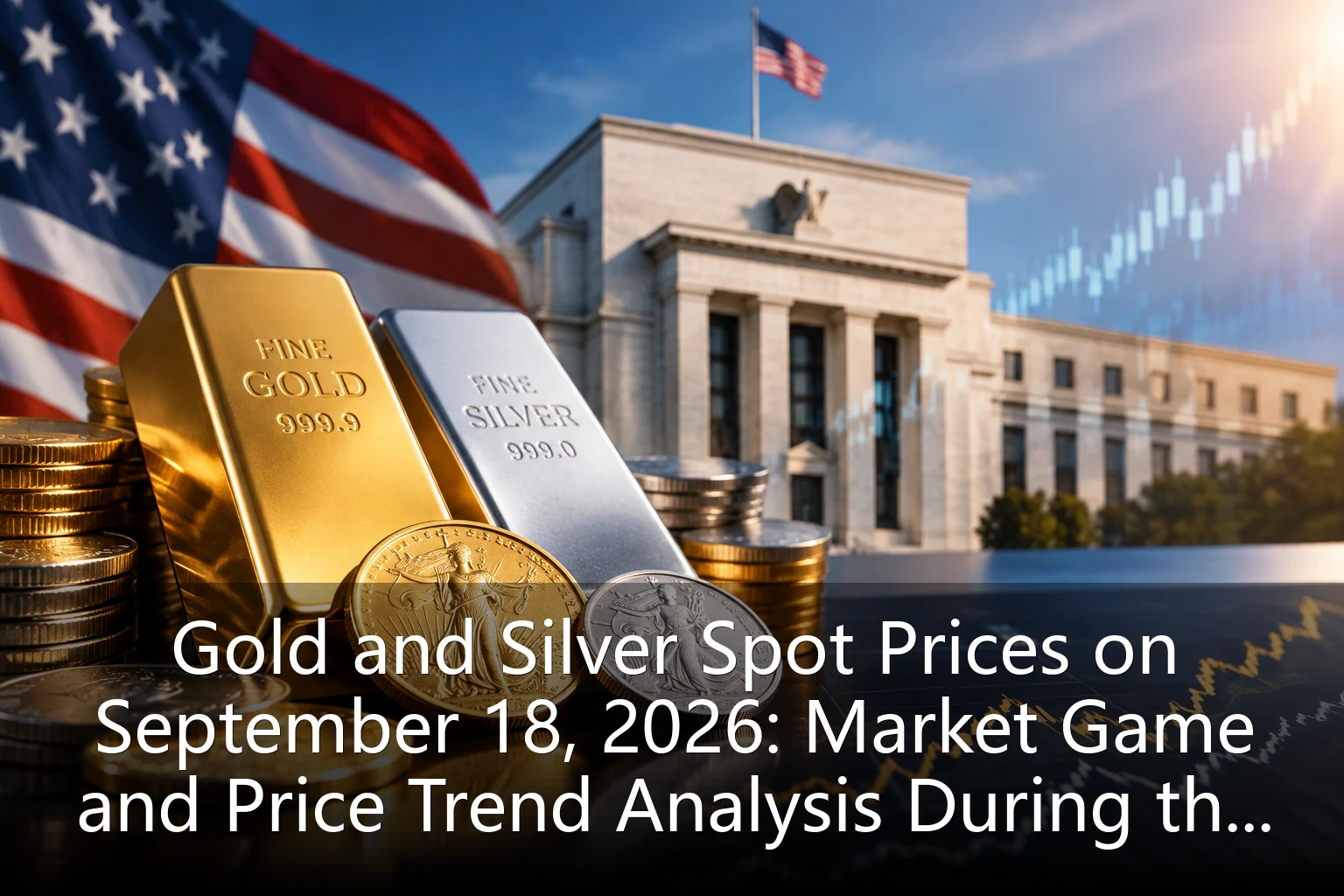
Today's precious metal market presents a complex and volatile situation. Gold prices maintain high-level fluctuations against the backdrop of Fed policy turn expectations, while silver shows different trends from gold due to fluctuations in industrial demand. As of 3 PM Beijing time, international spot gold quoted at $2985 per ounce, down 0.5% from the previous trading day; spot silver quoted at $31.25 per ounce, up 1.2%. This price trend reflects different interpretations of the Fed's policy direction and the internal differentiation in the precious metals market.
\n\nDuring the critical period of Fed policy turn, the precious metals market is experiencing unprecedented complex gaming. On one hand, US economic data shows that inflationary pressures still exist, providing support for gold; on the other hand, the resilience of the labor market has created divergences in market expectations for the timing of Fed rate cuts. The interweaving of these dual factors has caused gold and silver prices to show a consolidation trend in the short term.
\n\nMarket Gaming During the Fed Policy Turn Window Period
\n\nThe Fed's policy direction has always been the core factor affecting precious metal prices. Currently, the market is closely watching the latest statements from Fed officials and upcoming economic data. According to the latest meeting minutes, there are divergences within the Fed regarding inflation trends, with some officials believing inflation has approached the target and can start considering rate cuts; while others emphasize that inflation still has uncertainties and should maintain current interest rates.
\n\nThis policy divergence is directly reflected in the market, causing gold prices to fluctuate repeatedly in the $2970-3000 range. Market analysts generally believe that the Fed's policy turn will be the key factor determining the precious metals' second-half trend. Zhang Ming, chief analyst at Ruihe Precious Metals Research Institute, stated: "The timing and magnitude of the Fed's policy turn will directly affect gold's investment appeal. If the Fed cuts rates too early, it may stimulate inflation rebound, which will strengthen gold's safe-haven attributes; while if rate cuts are delayed, it may increase economic downward pressure, which will also drive gold demand as a safe-haven asset."
\n\nNotably, despite the unclear direction of Fed policy, gold ETF holdings continue to increase. Data shows that as of September 15, global gold ETF holdings increased by 2.3% from the previous month to 3,287 tons, showing that institutional investors' long-term confidence in gold remains solid.
\n\nGold Price Trend Analysis: Resonance of Technical and Fundamental Factors
\n\nFrom a technical perspective, gold prices are currently near key support levels. The daily chart shows that gold prices find support around $2970, with the 30-day moving average also forming support. The MACD indicator shows weakening momentum, but the RSI indicator remains in a neutral-to-strong area, indicating relatively balanced market forces.
\n\nOn the fundamental side, the latest US economic data presents a complex situation. On one hand, August CPI data showed a year-on-year increase of 3.6%, higher than the Fed's 2% target, indicating that inflationary pressures still exist; on the other hand, retail sales data unexpectedly fell by 0.3%, indicating that consumer spending is cooling. This contradiction in economic data has made market expectations for future policy directions more divided.
\n\nGeopolitical factors also provide support for gold. Recent escalation of tensions in the Middle East and new fluctuations in US-EU relations have increased market risk aversion. The geopolitical risk premium has highlighted gold's value as a safe-haven asset.
\n\nSilver Price Trend: Dual Performance of Industrial Demand and Safe-haven Attributes
\n\nUnlike gold, silver prices showed strong resilience today, mainly supported by expectations of industrial demand. Silver has dual attributes as both an industrial metal and a precious metal, and its price trend is often affected by global economic prospects. Recently, as manufacturing PMI data from major global economies improved, market expectations for silver's industrial demand have increased.
\n\nTechnically, silver prices have broken through the key resistance level of $30, with short-term performance relatively stronger than gold. The daily chart shows that silver prices encounter resistance around $31, but the overall upward trend remains intact. The MACD indicator shows enhanced momentum, and the RSI indicator is in a strong area, indicating that silver may continue to fluctuate upward in the short term.
\n\nHowever, silver's high volatility also means its price trend may be more unstable. Market analysts point out that silver prices are greatly affected by industrial demand, while the global economic recovery outlook still has uncertainties, which may limit silver's upside potential.
\n\nMarket Outlook: The Divergent Pattern of Gold and Silver May Continue
\n\nLooking ahead, the divergent pattern in the gold and silver markets is likely to continue. For gold, under the dual support of Fed policy turn expectations and geopolitical risks, gold prices are expected to maintain a fluctuating upward trend. However, due to policy uncertainties in the short term, gold prices may fluctuate and consolidate in the $2950-3050 range.
\n\nFor silver, benefiting from improved industrial demand and the continuous development of the photovoltaic industry, silver prices may show relatively strong performance. Especially against the background of accelerating global energy transition, the demand for silver from the photovoltaic industry is expected to continue growing, providing long-term support for silver prices.
\n\nFor investors, in the current market environment, it is recommended to adopt a more cautious strategy. Gold can be used as a long-term safe-haven asset, while silver is more suitable for short-term trading or as an investment driven by industrial demand. At the same time, investors should closely monitor Fed policy changes, US economic data, and geopolitical risks, and adjust investment strategies in a timely manner.
\n\nThe Ruihe Precious Metals Investment Advisory team suggests that investors can adopt a "core-satellite" strategy, using gold as the core allocation of the investment portfolio while flexibly adjusting the allocation ratio of satellite assets like silver according to market changes. This strategy can capture investment opportunities in the precious metals market while controlling risks.
\n\nInstitutional Views: Re-evaluation of Gold and Silver Allocation Value
\n\nRecently, several international investment banks and financial institutions have released the latest precious metals market outlook. Goldman Sachs stated in its latest report that it maintains a "buy" rating on gold, expecting gold prices to break through $3100 in the next 12 months. Goldman Sachs analysts pointed out: "Under the dual background of Fed policy turn and geopolitical risks, gold's safe-haven attributes will be further strengthened, driving price increases."
\n\n"Although gold prices may face fluctuations in the short term, in the long run, gold's value as a strategic asset to hedge against inflation and geopolitical risks remains stable."——Goldman Sachs Precious Metals Research Team\n\n
In contrast, Morgan Stanley is more optimistic about silver. The bank predicted in its latest report that benefiting from improved industrial demand and the rapid development of the photovoltaic industry, silver prices could reach $35 within the next 12 months. Morgan Stanley analysts said: "Silver's industrial attributes give it unique investment value in the context of energy transition, especially driven by the continuous expansion of the photovoltaic industry."
\n\nDomestically, the "2026 H2 Precious Metals Market Outlook" report released by Ruihe Precious Metals Research Institute points out that the Fed's policy turn will be the key factor determining the precious metals trend in the second half of the year. The report suggests that investors pay attention to the following key nodes: the September Fed interest rate meeting, the US presidential election in October, and the last Fed interest rate meeting in December. The policy directions and market reactions at these time points will have an important impact on precious metal prices.
\n\nInvestment Strategy: Seizing Opportunities in the Divergent Market
\n\nIn the current divergent gold and silver market environment, investors should adopt more refined investment strategies. For gold, investors are advised to focus on the following investment opportunities:
\n\n- \n
- Allocate to physical gold or gold ETFs on dips, as long-term safe-haven assets \n
- Focus on gold mining stocks, especially companies with low-cost and high-efficiency advantages \n
- Consider gold options and other derivatives to capture price fluctuation opportunities while controlling risks \n
For silver investment, investors are advised to focus on the following areas:
\n\n- \n
- Silver demand related to the photovoltaic industry, focusing on leading solar energy companies \n
- Silver ETFs, especially those focused on silver mining companies \n
- Silver futures and options, utilizing silver's high volatility to obtain trading opportunities \n
It should be noted that due to silver's high price volatility, investors should pay more attention to risk management when participating in silver trading, set reasonable stop-loss levels, and avoid excessive leverage operations.
\n\nConclusion: Finding Certainty in Uncertainty
\n\nOverall, the gold and silver price trends on September 18, 2026 reflect the complex market gaming during the critical period of Fed policy turn. As a safe-haven asset, gold maintains high-level fluctuations supported by policy uncertainties and geopolitical risks; while silver, benefiting from improved industrial demand, shows relatively strong performance.
\n\nFor investors, in the current market environment, more attention should be paid to the diversification of asset allocation and refinement of risk management. Gold can be used as a core asset for long-term allocation, while silver can be used as a satellite asset to capture short-term trading opportunities. At the same time, closely monitoring Fed policy changes, US economic data, and geopolitical risks, and adjusting investment strategies in a timely manner, can help find certainty in uncertainty and seize investment opportunities in the precious metals market.
\n\nAs the Fed policy turn window period approaches, the precious metals market will face more uncertainties while also containing rich investment opportunities. Investors should remain rational, conduct thorough research and preparation, and actively participate in this opportunity-rich market with risks under control.