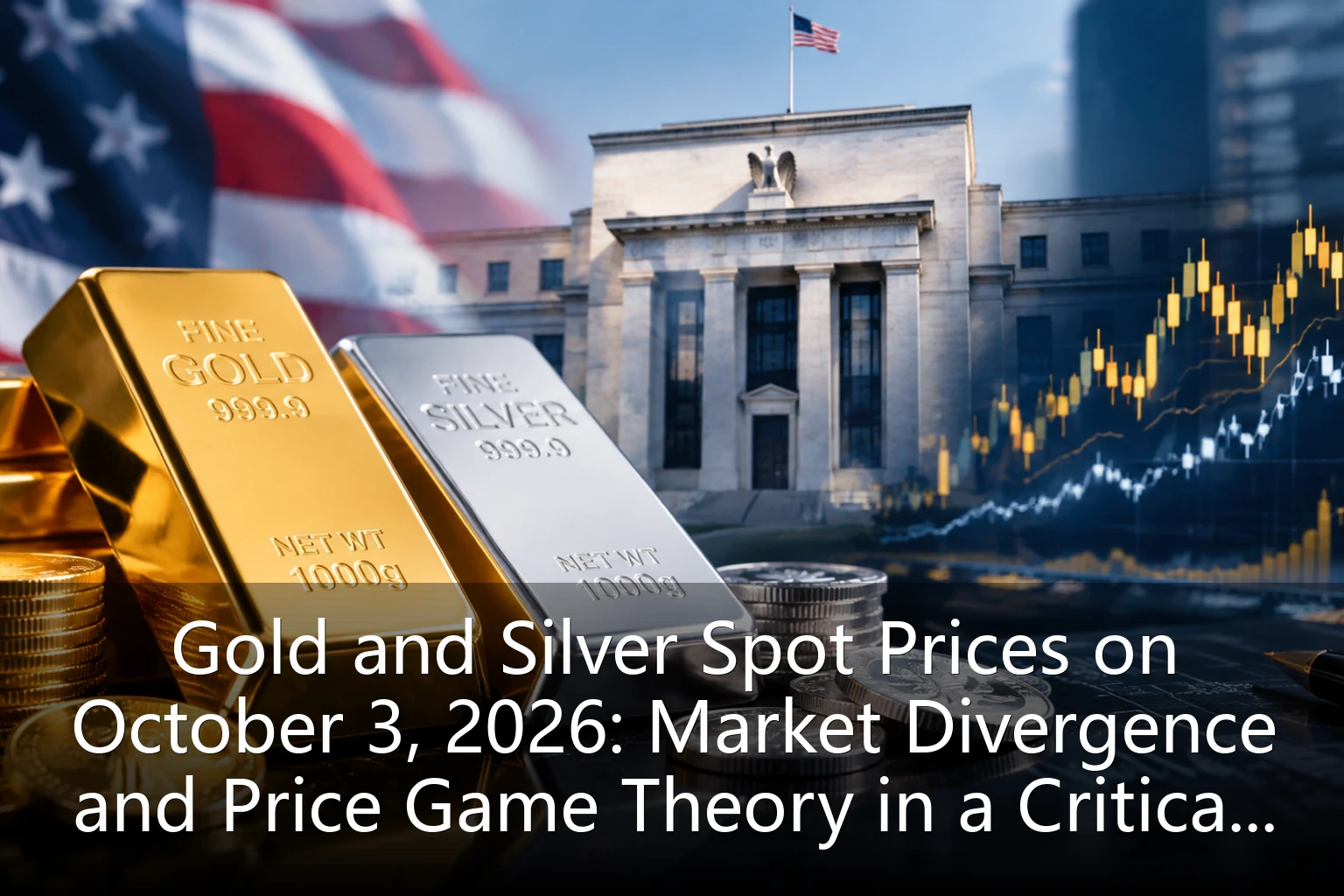
Gold and Silver Spot Prices on October 3, 2026: Market Divergence and Price Game Theory in a Critical Policy Turning Point
\nIn the global precious metals market on October 3, 2026, gold and silver prices showed clear divergent trends. During this critical period of Federal Reserve policy turning, market sentiment was complex and volatile, with investors seeking investment opportunities amid uncertainty. This article will conduct an in-depth analysis of the current price trends, influencing factors, and future outlook of the gold and silver markets, providing investors with comprehensive market interpretation and investment strategy references.
\n\nCurrent Price Performance of Gold and Silver Markets
\nAs of October 3, 2026, international gold prices maintained a high-level fluctuation trend during this critical period of Federal Reserve policy turning. As a traditional safe-haven asset, gold continues to serve its "haven" function against the backdrop of increasing global economic uncertainty. Meanwhile, silver prices, influenced by fluctuations in industrial demand, showed relatively independent movements, leading to new changes in the gold-silver price ratio.
\n\nThe performance of the gold market is mainly affected by the following factors: first, the continued geopolitical tensions globally have prompted investors to increase gold allocations; second, the divergence in monetary policy among major economies and the strengthening expectations of Federal Reserve policy turning have once again highlighted gold's value as a tool to hedge against currency depreciation; third, although global inflationary pressures have eased, they remain at relatively high levels, and gold's value preservation function has been recognized by the market.
\n\nThe Impact of Federal Reserve Policy Turning on Gold and Silver Markets
\nCurrently, the Federal Reserve is in a critical window period of policy turning, and the constantly changing expectations of interest rate cuts have become the core factor affecting gold and silver prices. According to the latest economic data, although the US inflation rate has fallen from its peak, core inflation remains sticky, and while the employment market has cooled, it maintains relative resilience. This complex combination of economic data poses challenges for the Federal Reserve's policy decisions and leads to continuous adjustments in market expectations for future interest rate paths.
\n\nAgainst the backdrop of strengthening expectations of policy turning, the gold market has shown typical safe-haven attributes. Historical data shows that during each Federal Reserve policy turning cycle, gold often achieves excess returns. This mainly stems from two factors: first, in a declining real interest rate environment, the holding cost of gold as a non-interest-bearing asset decreases; second, with enhanced expectations of dollar weakness, the advantage of gold being priced in US dollars becomes more pronounced.
\n\nAnalysis of Divergent Trends in Gold and Silver Markets
\nOn October 3, 2026, the gold and silver markets showed clear divergent trends. Supported by expectations of Federal Reserve policy turning, gold prices maintained relative strength, while silver prices, influenced by fluctuations in industrial demand and speculative capital flows, exhibited greater volatility. This divergent trend reflects the different attribute characteristics and market driving forces of the two metals.
\n\nAs a safe-haven asset, gold prices are mainly influenced by macroeconomic factors and investor sentiment. Against the backdrop of increasing global economic uncertainty, gold's safe-haven attributes are fully reflected. Data shows that gold ETF holdings have continued to increase recently, indicating that institutional investors' demand for gold allocation is steadily rising.
\n\nIn contrast, silver has both industrial and financial attributes, making its price trend more complex. On one hand, as an industrial metal, silver prices are directly affected by global economic prosperity, manufacturing PMI and other indicators. On the other hand, as a precious metal, silver prices are also influenced by investment demand and risk sentiment. This dual nature makes silver price volatility typically higher than gold's, and the gold-silver ratio thus shows cyclical changes.
\n\nAnalysis of Key Factors Affecting Gold and Silver Prices
\nAn in-depth analysis of the current gold and silver markets reveals several key factors currently dominating price trends:
\n\n- \n
- Federal Reserve Monetary Policy Path: The timing and pace of the Federal Reserve's policy turning are core factors affecting gold and silver prices. Changes in market expectations for interest rate cuts are directly reflected in the volatility of gold and silver prices. \n
- US Dollar Exchange Rate Trend: The US dollar index and gold and silver prices usually show a negative correlation. A weakening dollar often boosts gold and silver prices, and vice versa. \n
- Geopolitical Risks: The intensification of global geopolitical tensions prompts investors to increase gold allocations, pushing up gold prices. \n
- Inflation Expectation Changes: Changes in inflation expectations directly affect gold's value preservation function, thereby affecting investor demand for gold. \n
- Global Economic Growth Outlook: Expectations of slowing global economic growth put pressure on silver's industrial demand, affecting silver prices. \n
- Institutional Capital Flows: Changes in holdings by large institutional investors and ETFs are important indicators reflecting market sentiment and capital flows. \n
Market Outlook and Investment Strategies
\nLooking ahead, the gold and silver markets will remain in a game-theory pattern during the critical period of policy turning. In terms of gold, supported by increasing global economic uncertainty and expectations of Federal Reserve policy turning, gold prices are expected to maintain a strong trend. For silver, its industrial demand volatility and speculative attributes will lead to increased price volatility, requiring investors to pay more attention to macroeconomic data and industry demand changes.
\n\nFor different types of investors, we propose the following investment strategy recommendations:
\n\nFor Long-term Investors
\nLong-term investors can continue to treat gold as an important part of asset allocation, using gold's safe-haven attributes to hedge against systemic risks. It is recommended to use regular fixed-amount investment methods to smooth the impact of market fluctuations on the investment portfolio. At the same time, one can appropriately pay attention to the long-term allocation value of silver, but need to control its proportion in the overall asset allocation.
\n\nFor Short-term Traders
\nShort-term traders need to closely monitor Federal Reserve policy signals, economic data releases, and market sentiment changes. During the critical period of policy turning, market volatility often increases, creating more trading opportunities. It is recommended to combine technical analysis with fundamental analysis, set reasonable stop-loss and take-profit points, and control risk exposure.
\n\nFor Institutional Investors
\nInstitutional investors can consider appropriately increasing the proportion of gold allocation in their investment portfolios to respond to global economic uncertainty. At the same time, they can use derivatives such as gold and silver futures and options for risk hedging and return enhancement. Additionally, monitor the capital flows of gold ETFs and silver ETFs to grasp market sentiment changes.
\n\nConclusion
\nThe gold and silver markets on October 3, 2026 are in a game-theory pattern during the critical period of policy turning. With its safe-haven attributes, gold maintains strength against the backdrop of increasing global uncertainty, while silver, due to its dual characteristics of industrial and investment attributes, shows greater volatility. Investors need to closely monitor Federal Reserve policy movements, economic data changes, and market sentiment fluctuations, and formulate appropriate investment strategies based on their own risk tolerance and investment objectives.
\n\nIn the current complex and volatile market environment, precious metals, as an important part of asset allocation, have once again received market recognition of their value. Whether long-term investors or short-term traders, all need to maintain rationality, adjust strategies in a timely manner according to market changes, and find deterministic investment opportunities amid uncertainty.
\n\nIn the future, as the Federal Reserve's policy turning becomes gradually clearer, the gold and silver markets will welcome new investment opportunities and challenges. Investors need to maintain close attention, respond flexibly, grasp the market pulse during the critical period of policy turning, and achieve asset preservation and appreciation.