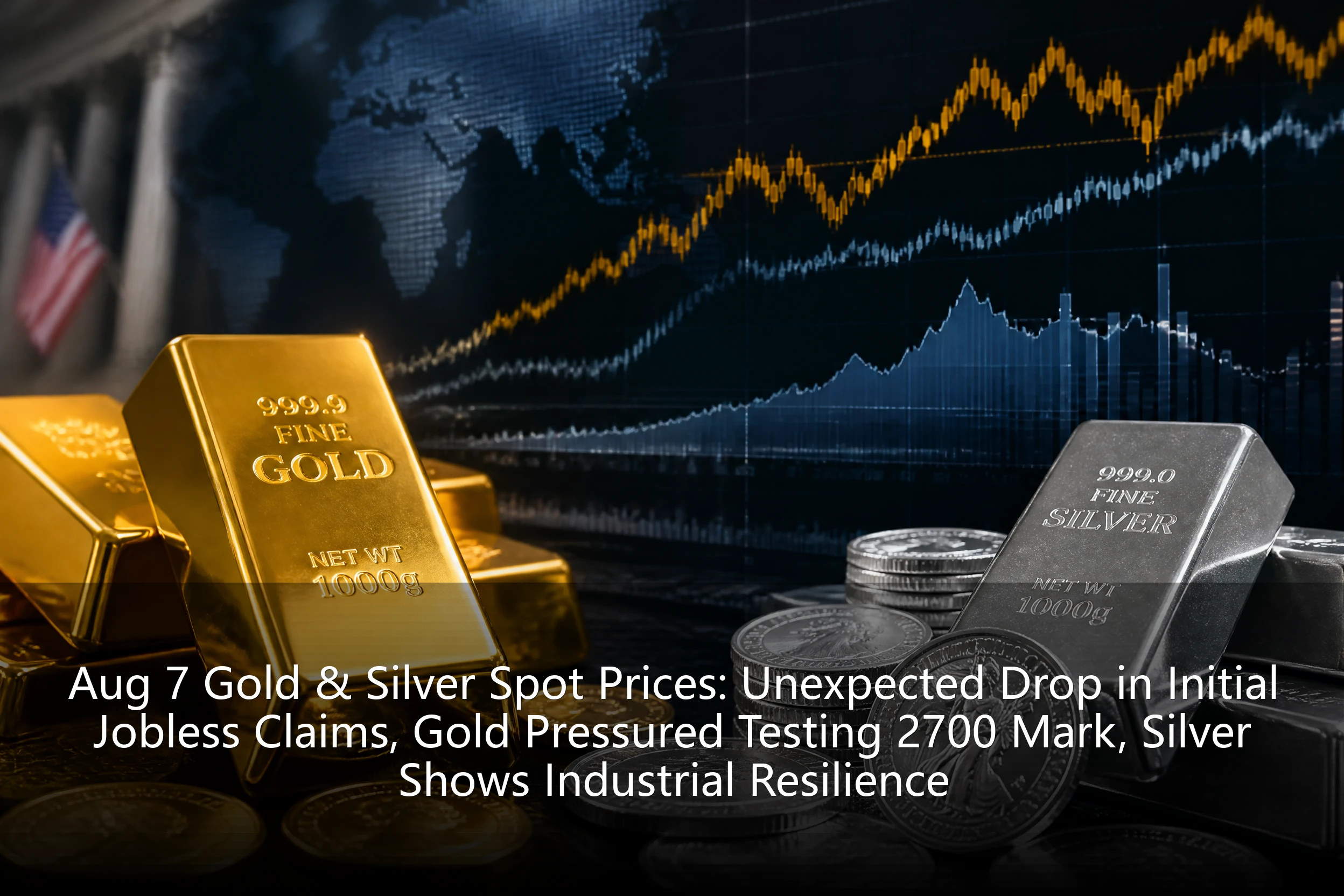
Aug 7 Gold & Silver Spot Prices: Unexpected Drop in Initial Jobless Claims, Gold Pressured Testing 2700 Mark, Silver Shows Industrial Resilience
On August 7, 2026, the COMEX gold futures market experienced a significant directional adjustment. Following the release of the latest US weekly initial jobless claims data, safe-haven funds that had poured into the precious metals market due to recession fears saw a brief bout of profit-taking. Today's gold price dipped to near the key support level of $2,700 per ounce during the session, while silver prices showed relative resilience under the strong support of industrial demand, holding steadily above $42 per ounce. For investors following Ruihe Precious Metals (ruihewp.com), understanding the macroeconomic logic behind today's price fluctuations is crucial for grasping the H2 precious metals market.
Initial Jobless Claims Unexpectedly Fall, US Dollar Rebound Suppresses Today's Gold Price
At 8:30 PM Beijing time last night, the US Department of Labor released the initial jobless claims for the week ending August 2. The data showed an unexpected drop to 215,000, below the market's previous expectation of 228,000, while the previous figure was also revised down from 231,000 to 226,000. The release of this data was like a bucket of cold water, extinguishing the recent market panic over an impending "hard landing" of the US economy.
Immediately after the data release, the US Dollar Index surged by over 40 basis points in the short term, returning above the 104 mark. In contrast, real-time gold prices experienced a rapid decline. The main COMEX gold futures contract price plummeted from an intraday high of $2,750 to $2,705, with an intraday drop exceeding 1.2% at one point. Spot gold prices also moved lower in tandem, losing the support level of $2,710 per ounce.
From a macroeconomic logic perspective, the decline in initial jobless claims indicates that the US labor market still maintains relative resilience. Although the previously weak July nonfarm payrolls report triggered market expectations that the Fed might need to adopt a more aggressive rate-cutting policy, this week's initial claims data poured cold water on such expectations. If subsequent economic data continues to show that the US economy is not falling off a cliff, the Fed is highly likely to maintain a 25-basis-point rate cut at its September meeting, rather than the 50 basis points expected by some institutions. This revision of expectations directly led to a rebound in US Treasury yields, thereby exerting short-term downward pressure on the non-yielding asset, gold.
Geopolitical Premium and Central Bank Gold Purchases Provide Support, Gold's 2700 Mark Support Remains Strong
Although today's gold price was pressured by the unexpectedly strong employment data, looking at the full day's trading, gold still received very strong buying support near the $2,700 per ounce mark. This support mainly stems from two dimensions: the persistent premium from geopolitical risks and strategic gold purchases by global central banks.
First, on the geopolitical front, tensions in the Middle East have not seen a substantive easing. Recent controversies surrounding Iran's nuclear facilities and intermittent disruptions in Red Sea shipping routes have kept market risk sentiment at elevated levels. As a traditional safe-haven asset, gold prices already include a substantial geopolitical premium. As long as these uncertainties persist, the downside space for gold prices will be greatly limited.
Secondly, the wave of gold purchases by global central banks continues. According to a recent report by the World Gold Council, global central bank gold purchases hit a new high in the first half of 2026. Despite gold prices being at historical highs, central banks of emerging market countries continue to firmly increase their gold holdings to meet the need for foreign reserve diversification. This state-level long-term buying has built a solid "floor" for gold prices. When today's gold price dipped near $2,700, the Asian market showed clear signs of physical buying absorption, indicating that globally, the fundamental demand for physical gold remains very healthy.
Silver's Industrial Attributes Highlighted, Resilience Superior to Gold
In stark contrast to gold's pullback, today's silver prices showed extremely strong resilience. COMEX silver futures prices briefly touched a low of $41.8 per ounce before rebounding quickly, eventually stabilizing around $42.3 per ounce, with an intraday drop of less than 0.5%. The further narrowing of the gold-silver ratio once again confirmed silver's unique allocation value in the current macro environment.
The core driver behind silver's ability to chart an independent course lies in its strong industrial demand. In 2026, the global energy transition entered an accelerated phase, and the explosive growth of AI data centers, in particular, has provided a massive boost to the photovoltaic industry and electronic components. As an indispensable conductive material in solar panels and electronic devices, silver's industrial demand now accounts for nearly 60% of its total demand.
Although recent US manufacturing data has shown a certain degree of slowdown, globally, especially in major Asian economies, infrastructure investment in the new energy sector continues to maintain double-digit growth. This structural difference in demand makes silver less sensitive to short-term US macro employment data compared to gold. In addition, silver's mine supply has lacked elasticity in recent years, primarily because silver is mostly a byproduct of copper and lead-zinc mining; when main metal prices are depressed, silver supply is also restricted. The continuously widening supply-demand gap provides a solid bottom support for silver prices.
Fed Policy Path Outlook: Rate Cut Cycle Begins, Precious Metals Bull Market Logic Unchanged
Standing at the time node of August 2026, we need to look beyond short-term data fluctuations and examine the Fed's policy path and its long-term impact on the precious metals market from a more macro perspective.
Although today's initial jobless claims data eased short-term recession fears, it has not changed the basic expectation that the Fed is about to start a rate-cutting cycle in September. While US inflation has retreated from its peak, it has not yet reached the Fed's 2% long-term target, and the slowdown in economic growth is an indisputable fact. Between "preventing inflation" and "preventing recession," the Fed's focus is quietly tilting toward the latter.
From historical experience, in the early stages of a Fed rate-cutting cycle, gold often goes through a period of consolidation as the market digests the front-running rate cut expectations. However, once the rate-cutting cycle is officially established, the trend of lower real interest rates will inevitably boost gold's holding appeal. For investors, short-term pullbacks are not the end of a bull market but rather a strategic opportunity to buy on dips.
Furthermore, the increasingly heavy debt burden of the US federal government is also an important cornerstone supporting precious metals prices. In 2026, the scale of US national debt exceeded $38 trillion, and high interest payments are eroding the government's fiscal space. This long-term expectation of monetizing fiscal deficits puts the long-term credit of the US dollar to the test, and as the ultimate credit hedge tool, gold's strategic allocation value is irreplaceable in the current cycle.
Gold & Silver Trading Strategies: Seize Pullback Opportunities, Focus on Key Support Levels
Regarding today's gold and silver price trends, the Ruihe Precious Metals research team provides the following trading strategy references for investors:
- For Gold: Today's pullback in gold prices is a typical technical correction, and $2,700 per ounce is a key long-short watershed. If this level can hold steadily in subsequent trading days, the market is likely to regroup and challenge the $2,800 mark. Investors may consider building long positions in batches within the $2,700-$2,720 range, with a strict stop-loss set at $2,670 below. From a weekly chart perspective, gold's upward channel remains intact, and every pullback near the lower rail is a good entry opportunity.
- For Silver: Silver's resilience near the $42 level indicates active buying below. Compared to gold, silver has higher volatility, but bolstered by industrial demand, its upward elasticity is also stronger. Investors should watch for silver's consolidation in the $42-$43 range; a breakout above the previous high resistance of $44 could open a trend channel toward $45 or even higher. For short-term operations, use $41.5 as a defense line and buy on dips.
- Asset Allocation Advice: For long-term asset allocators, the current stage should not focus excessively on short-term price fluctuations. It is recommended to maintain a 10%-15% precious metals allocation in the investment portfolio. In terms of specific asset selection, in addition to direct investment in physical gold and silver bars, high-quality gold and silver mining stocks and precious metals ETFs are also excellent tools for risk diversification.
Conclusion: Short-Term Volatility Does Not Change the Long-Term Bull Market Pattern
In summary, the spot price fluctuations of gold and silver on August 7, 2026, are essentially the market's process of digesting the short-term bearish factor of an unexpected drop in US employment data. The decline in initial jobless claims has temporarily suppressed safe-haven sentiment, but it cannot fundamentally reverse the broad trend of a global macro environment favoring precious metals. The complexity of geopolitics, the persistence of central bank gold purchases, the explosive nature of silver's industrial demand, and the approaching Fed rate-cutting cycle jointly form a solid bottom for precious metals prices.
In future trading days, investors need to closely monitor the upcoming US Consumer Price Index (CPI) and Producer Price Index (PPI) data to be released next week, which will provide clearer guidance for the Fed's rate cut magnitude in September. Ruihe Precious Metals (ruihewp.com) will continue to track the latest US economic data, Fed policy trends, and real-time gold and silver markets, providing you with professional, in-depth investment decision references. In this era full of uncertainties, the value of precious metals as the ballast of asset allocation is being recognized by an increasing number of market participants.