I. Intraday Alert: Gold Surges to Recover Losses, Silver Follows Suit
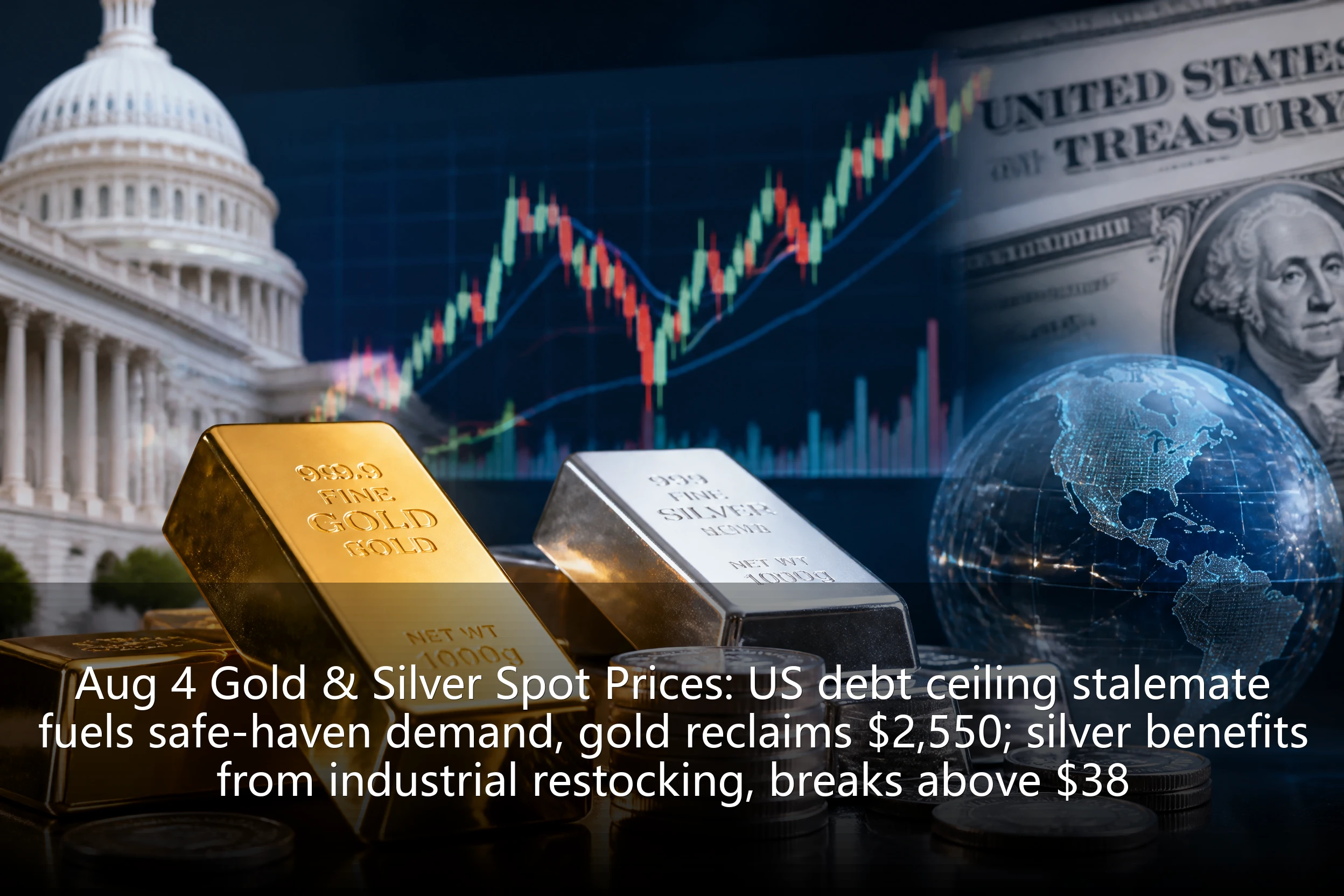
On the evening of August 4 Beijing time, the precious metals market saw a strong wave of safe-haven buying. As of press time, spot gold was trading at $2,552.40 per ounce, up over 1.2% for the day, not only fully recovering Friday's profit-taking losses but also firmly holding above the psychological $2,550 level. Meanwhile, spot silver performed even more impressively, with intraday gains widening to 2.5% and the price touching $38.20 per ounce, a new high for the past week.
The sudden surge in gold and silver prices was primarily driven by a political stalemate from Washington, D.C. With less than 48 hours until the US Treasury runs out of funds, Congressional parties have yet to reach any substantive agreement on raising or suspending the debt ceiling. As default risk escalates sharply, investors are dumping short-term US Treasuries and flocking to traditional safe-haven assets like gold.
2. In-Depth Analysis: Why Does the Debt Ceiling 'Cry Wolf' Keep Working?
Although historically US debt ceiling crises have always ended without disaster, the 2026 standoff appears particularly perilous. Rating agency Moody's stated in a recent report that if no clear resolution is seen by August 6, the US faces a technical risk of partial debt default, which would be unprecedented.
This extreme uncertainty is directly reflected in gold prices. As a zero-credit-risk asset, gold is a direct hedge against fiat currency credit risk. When markets begin pricing in potential delays in US Treasury payments, gold's monetary attribute is instantly activated. This is why gold prices surged from near $2,520 to $2,550 in just a few hours. Additionally, growing market expectations that the Fed may pause its balance sheet reduction or even make an emergency rate cut in September are further depressing real interest rates, providing dual momentum for the rise in gold and silver spot prices.
2. Silver's Independent Rally: Industrial Restocking and Solar Demand Resonance
Unlike gold's purely safe-haven-driven move, silver's rally showcased its strong 'dual-attribute' advantage. Beyond following gold's safe-haven sentiment, silver received substantial support from industrial demand.
Newly released data shows that due to peak summer electricity consumption and a surge in solar panel installations, global purchases of photovoltaic silver paste saw significant restocking demand in early August. As a key raw material for solar panels, silver's industrial consumption is expected to hit a record high in 2026. With industrial and safe-haven buying resonating, silver successfully broke through the previous resistance level of $37.50. From a technical perspective, silver's 'bull flag' consolidation appears near its end, and a breakout above the $39 round number may only be a matter of time.
3. Technical Analysis: Can Gold Hold $2,550?
From a technical perspective, gold formed a decisive long bullish candle on the 4-hour chart, piercing through the previous moving average resistance zone. $2,550 is not only a round number but also a short-term battleground for bulls and bears.
- Key Support: $2,520. This is the intraday starting point and a high-volume area before the non-farm payroll data release. As long as prices stay above this zone, the short-term bullish sentiment remains intact.
- Upside Resistance: $2,580. This is near the all-time high set in late July. If default fears escalate into real panic in the next 48 hours, gold prices are very likely to test and break this record high, challenging the $2,600 mark.
- Silver Outlook: Silver is now firmly above $38, with the next resistance at $38.80. Investors should closely monitor the gold/silver ratio, currently hovering near 67, a recent low, indicating silver's volatility elasticity is significantly higher than gold's.
4. Market Outlook: The Battle of Non-Farm Payrolls and the Debt Ceiling
For precious metals investors, this week will be a pivotal moment determining the trend for the second half of the year. Besides the sword of the debt ceiling hanging overhead, the upcoming US July non-farm payrolls report on Friday is another major market event.
If the jobs data is weak, combined with default risk, the Fed will face immense political pressure, potentially forcing a more dovish stance at its September meeting or even an early end to balance sheet reduction. This macro environment is extremely favorable for gold and silver. Conversely, if the debt ceiling is resolved at the last minute and non-farm payrolls are strong, gold could face a brief 'sell the fact' pullback. However, in the medium to long term, the global trend of central bank gold purchases remains intact, and every dip will be a good opportunity to accumulate gold assets. The Ruijin Research Team advises investors to closely monitor changes in the US 10-year Treasury yield; if yields fluctuate abnormally due to surging default risk, the safe-haven premium for precious metals will rapidly expand.