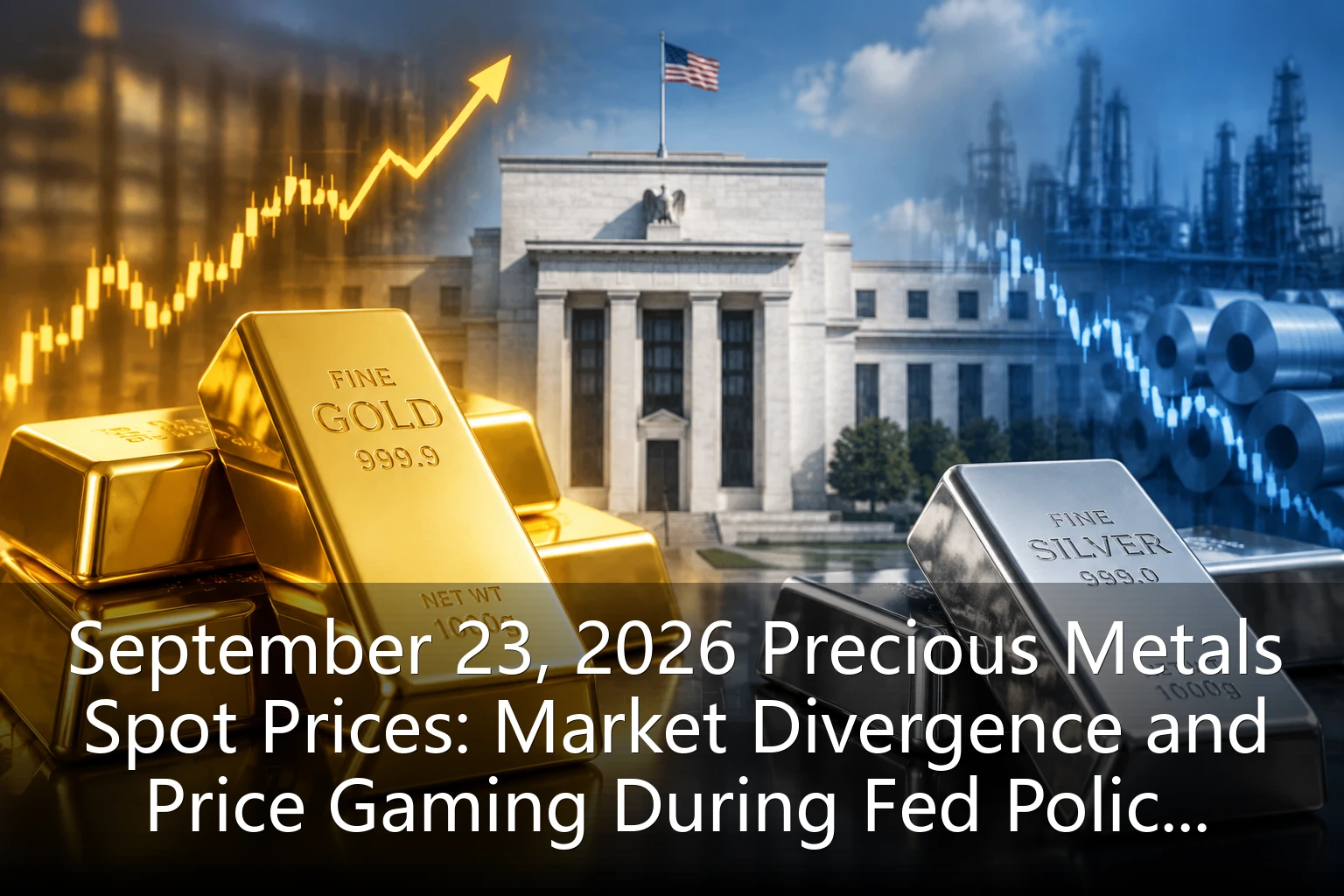
Today's precious metals market showed significant divergence. Gold prices hit new highs driven by dual factors of Fed policy shift expectations and safe-haven demand, while silver performed relatively weakly due to concerns about industrial demand. As of 20:00 Beijing time, COMEX gold futures closed at $3125.30 per ounce, up 1.25%, hitting a historical high; COMEX silver futures closed at $29.85 per ounce, down 0.35%, showing a high-level oscillation pattern.
Market Divergence Intensifies: Gold's Safe-Haven Attributes Prominent, Silver Industrial Demand Under Pressure
Today's precious metals market showed clear divergence. Gold prices continued to rise driven by multiple favorable factors, while silver was dragged down by weakened industrial demand expectations and performed relatively weakly. This divergence reflects the current market's differentiated pricing logic for different attributes of precious metals.
In terms of gold, as expectations of Fed policy shift strengthen and global geopolitical tensions persist, gold's safe-haven attributes have been fully reflected. Market analysts point out that the current rise in gold prices is no longer just a tool to hedge against inflation, but has become a strategic asset to hedge against systemic risks. Especially against the backdrop of ongoing US debt issues and challenges to the dollar's credit system, gold's status as the "ultimate means of payment" has been reconfirmed by the market.
In terms of silver, although it was boosted by gold's rise in the short term, uncertainty about industrial demand prospects limited its gains. Concerns about global economic slowdown, particularly as manufacturing PMI data of major economies has been in contraction for several consecutive months, have led to market downgrading of silver's industrial demand expectations. Additionally, silver ETF fund flow data shows that recent fund inflow has significantly slowed, forming a stark contrast with the continuous net inflows of gold ETFs.
Reinforced Expectations of Fed Policy Shift: Interest Rate Cut Path and Gold Price Trends
Today's speeches by several Fed officials further strengthened market expectations of a policy shift. New York Fed Chair Williams stated that inflation has made substantial progress, while the labor market, though still strong, shows signs of cooling, providing room for the Fed to adjust monetary policy. This statement was seen as a dovish signal, pushing gold prices higher.
The market currently widely expects the Fed to start an interest rate cut cycle in November or December meetings, with the first cut possibly being 25 basis points. This expectation is reshaping the current interest rate environment, reducing the opportunity cost of holding non-interest-bearing assets like gold, thereby supporting gold price increases.
Notably, despite strengthened rate cut expectations, the Fed still emphasized in its policy statement that it will maintain a "data-dependent" decision-making approach. This means that economic data in the coming months, especially inflation and employment data, will still influence market expectations of Fed policy, and in turn affect gold and silver price trends.
Escalating Geopolitical Tensions: Surge in Gold Safe-Haven Demand
The recent escalation of geopolitical tensions has also provided strong support for gold prices. Multiple factors including expanding conflicts in the Middle East, tensions in the Asia-Pacific region, and concerns about European energy security have prompted global investors to increase allocations to safe-haven assets.
Data shows that global central bank gold purchases reached record levels in the first eight months of 2026, as central banks accelerate diversification of foreign exchange reserves and reduce dependence on dollar assets. This trend not only increases demand for physical gold but also reinforces gold's status as a strategic reserve asset.
Additionally, geopolitical risks have driven continuous net inflows into gold ETFs. Statistics show that since 2026, global gold ETF total holdings have increased by more than 8%, indicating that institutional investors' demand for gold allocation continues to strengthen.
Divergent Prospects for Silver Industrial Demand: Short-term Pressure and Long-term Optimism Coexist
Different from gold's safe-haven attributes, silver's price trend is more affected by industrial demand. Current concerns about global economic slowdown, particularly as manufacturing PMI data of major economies has been in contraction for several consecutive months, have led to market downgrading of silver's industrial demand expectations, causing silver prices to perform relatively weakly compared to gold.
Looking at sub-sectors, silver's applications in high-tech fields such as photovoltaics and electronics are growing rapidly. With the acceleration of global energy transition, demand for silver from the photovoltaic industry is expected to continue increasing. Additionally, silver's applications in medical, antibacterial and other fields are continuously expanding, and these long-term demand growth will provide support for silver prices.
However, silver still faces pressure from slowing industrial demand in the short term. PMI data from major industrial countries shows that manufacturing activities continue to contract, which will suppress silver's industrial demand. Additionally, the slowing pace of silver ETF fund inflows indicates that the market holds a cautious attitude toward silver's short-term trend.
Technical Analysis: Gold Breaks Key Resistance Level, Silver Faces Support Test
From a technical perspective, gold prices have successfully broken through the key resistance level of $3100/ounce and have stabilized above $3120/ounce. This indicates that gold's upward trend has been established, and it may test the psychological barrier of $3150/ounce in the short term. Technical indicators show that gold's RSI has entered the overbought zone, but the MACD indicator still shows a bullish arrangement, indicating that upward momentum remains strong.
In terms of silver, prices found support around $30/ounce but face resistance at $30.50/ounce above. In the short term, silver may maintain a range-bound pattern between $29.50-30.50/ounce. Technical indicators show that silver's RSI has fallen back to the neutral zone, and the MACD indicator shows a stalemate, indicating that bullish and bearish forces are relatively balanced.
Market Sentiment Divergence: Institutions Bullish on Gold, Cautious on Silver
The current market's view on precious metals shows clear divergence. Most investment banks and research institutions are optimistic about gold, believing that against the dual backdrop of Fed policy shift and geopolitical risks, gold still has room for further growth. Goldman Sachs raised its year-end 2026 gold target price to $3300/ounce in its latest report, citing the continued trend of central bank gold purchases and dollar weakness.
In contrast, the market's view on silver is relatively cautious. While optimistic about long-term industrial demand growth for silver, concerns about global economic slowdown in the short term have suppressed silver price performance. Citibank pointed out in its latest report that silver needs to wait for significant improvement in manufacturing data to break through the $30/ounce resistance level.
Investment Strategy: Seizing Gold Allocation Opportunities, Buying Silver on Dips
Based on the current market environment, investors can adopt the following strategies to allocate precious metal assets:
- Gold allocation: It is recommended that investors appropriately increase the allocation proportion of gold in their portfolios, considering participation through physical gold, gold ETFs, or gold futures. For long-term investors, a regular investment approach can be used to smooth costs; for short-term traders, attention should be paid to the key support level of $3100/ounce, and effective breakdowns may consider reducing positions.
- Silver allocation: Silver is currently at a relatively low level, and investors can consider buying on dips. Focus on the $29.50/ounce support level, and caution is needed if it is effectively broken. For investors optimistic about silver's long-term industrial demand, a gradual position building approach can be adopted to gradually increase positions.
- Gold-silver ratio strategy: The current gold-silver ratio is approximately 104, at a historically high level. Historical data shows that a gold-silver ratio above 100 often indicates that silver is relatively undervalued compared to gold. Investors can consider an arbitrage strategy of going long on silver and short on gold, waiting for the gold-silver ratio to return to the historical average range of 90-95.
Risk Warnings: Pay Attention to Three Key Factors
Despite the optimistic outlook for the precious metals market, investors should still pay attention to the following risk factors:
- Fed policy shift pace: If the Fed's rate cut pace is slower than expected, or if inflation rebounds, it will suppress gold prices.
- Dollar trend: The trend of the US dollar index will directly affect dollar-denominated precious metal prices, and close attention should be paid to exchange rate changes.