Precious Metals Frenzy Sweeps the Globe: Silver Breaks 90, Copper and Tin Hit New Highs – 2026 Commodity Market Deep Dive
Keywords: Precious Metals, Silver, Tin, Copper, Fed Independence, Safe-Haven Demand, Industrial Metals, Asset Allocation
Introduction
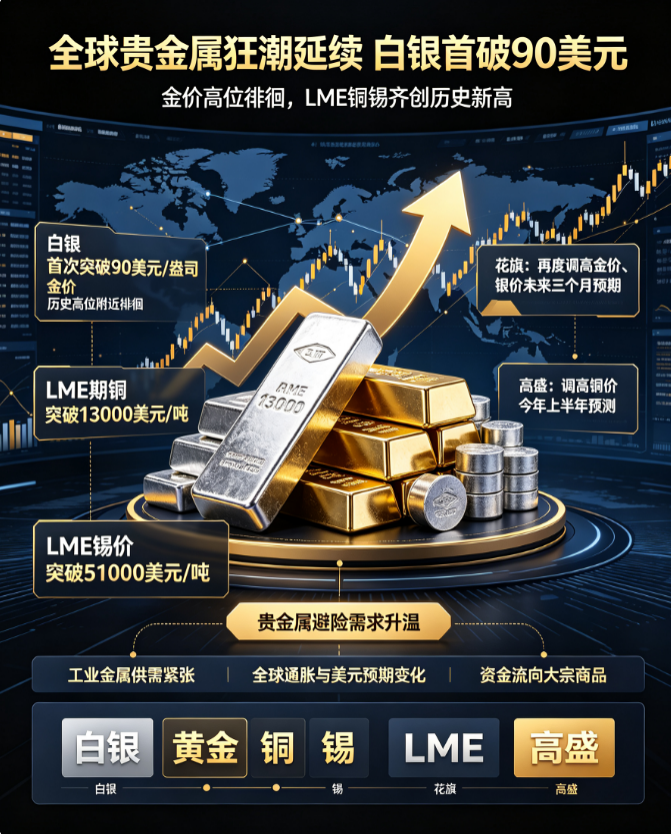
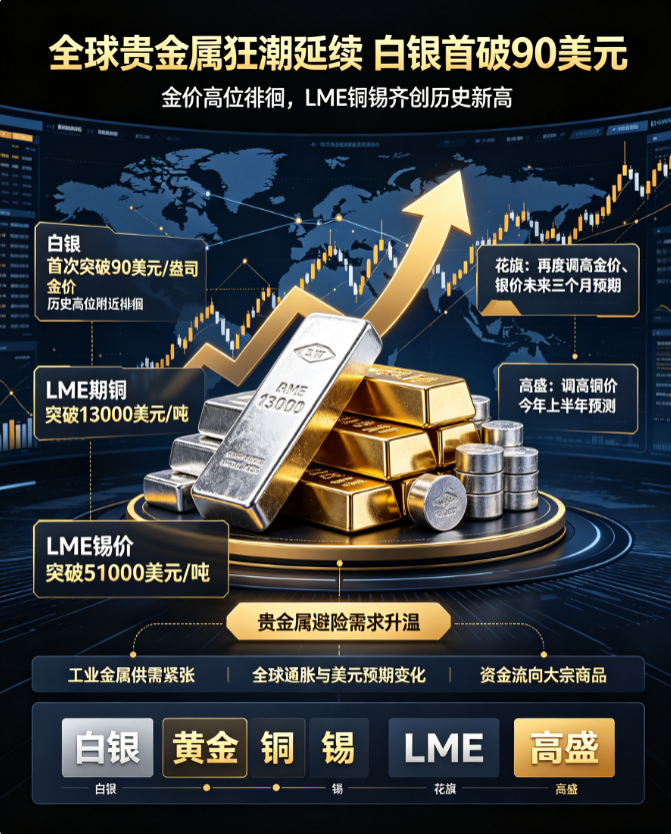
The global commodity market in 2026 is experiencing an unprecedented capital frenzy. Since the beginning of the year, prices of precious and industrial metals have risen in turn, repeatedly breaking records, triggering violent market fluctuations. During today's Asia-Pacific trading session, silver prices broke through the $90/ounce mark for the first time in history, with gold also hovering near its all-time high; London Metal Exchange (LME) tin broke through the key $51,000/ton level, and copper prices touched an all-time high above $13,000/ton. This commodity bull run, driven by multiple factors, is reshaping the logic of global asset pricing.
Gold and Silver Soar: Safe-Haven Frenzy Amid Geopolitical and Policy Struggles
Silver is undoubtedly the brightest star in this commodity frenzy. During today's Asia-Pacific trading session, silver prices surged 5.3% to a record high of $91.5535/ounce, having already broken through the $90 threshold with only a slight step away. More strikingly, gold is now only $10 away from its historical peak, and the market widely expects that breakthrough is inevitable.
This surge in precious metals is not merely a technical breakout but the result of multiple deep drivers resonating together. First, the conflict between US President Trump and Fed Chairman Powell has continued to escalate, with Powell even launching an unusually active counterattack, triggering deep concerns about Fed independence. JPMorgan Chase CEO Jamie Dimon pointed out that although many central bank governors globally have voiced support for Powell, external intervention may backfire and further shake market confidence.
Invesco Asia-Pacific Global Market Strategist Zhao Yaoting stressed in an interview: "Central bank independence is the cornerstone of financial market stability. Any potential weakening of Fed autonomy, even just the 'perception' of weakening, could undermine confidence in monetary policy and the entire financial system." This institutional uncertainty has become the core underlying logic for the rise in gold and silver.
Additionally, the US core inflation rate for December was lower than expected, raising market expectations for another rate cut by the Fed within the year. Swap market pricing indicates that investors expect the Fed to cut rates at least twice more later this year. Geopolitical tensions in Venezuela, Iran, etc., continue to escalate, further boosting safe-haven demand. So far in 2026, spot gold has accumulated a gain of nearly 7%, spot silver has soared 23%, and platinum has also risen 15%, approaching historical peaks. It should be emphasized that this rally is built on the astonishing base of 2025, when gold and silver rose 145% and 65% respectively.
Citigroup this week raised its three-month price forecasts for gold and silver to $5,000/oz and $100/oz respectively. Hong Hao, Chief Investment Officer of Lotus Asset Management, said that silver is benefiting from a broader commodity rotation and could reach $150/oz by year-end. Zhao Yaoting added that although the gains are unlikely to be as strong as in 2025, demand for gold and silver as hedges against inflation or financial instability should continue this year, and gold may outperform silver this year.
Industrial Metals Lead: Rotation Logic from 'Divine Copper' to 'Raging Tin'
Driven by the precious metals frenzy, the industrial metals market has also seen massive waves. During today's Asia-Pacific trading session, LME tin surged 4.3% at one point to a record high of $51,675/ton, surpassing the previous high in 2022. Tin is the least liquid of the six major LME metals, but its gains have been staggering—nearly 40% last year, and over 25% so far in 2026. Shanghai Metal Futures Exchange tin prices rose another 9% today, hitting the daily limit, to a record high of 413,170 yuan/ton (approx. $59,212/ton). This week, tin futures on the exchange have hit the limit for the second time.
Hong Hao pointed out that the price surge stems from Chinese investors flooding into global precious and industrial metals markets, with some large equity funds also betting that commodity futures will rally sharply alongside equities.
The copper story is equally gripping. LME copper prices hit an all-time high of $13,387.50/ton on January 6, surging from below $11,000/ton at the end of November 2025. Continued global demand recovery, coupled with demand from AI computing infrastructure, provides a solid logic for copper's rise. Goldman Sachs raised its H1 2026 copper price forecast from $11,525/ton to $12,750/ton, citing a 'scarcity premium' and hoarding nature being repriced, especially low inventories outside the US. However, Goldman also stressed that copper prices above $13,000/ton are unsustainable in the long run and maintained a cautious bearish forecast of $11,200/ton for Q4 2026 LME copper.
Deep Dive into Drivers: Capital Flows, Supply/Demand, and Allocation Logic
Behind this precious metals frenzy is strong capital flow support. Since late December 2025, trading volumes at the New York Mercantile Exchange and Shanghai Futures Exchange have remained at elevated levels, indicating active inflows from both institutions and retail investors.
From a supply-demand perspective, industrial metals such as copper, aluminum, and nickel all face long-term supply gaps. Dai Min, Director of Multi-Asset Investment Strategy at Fidelity Funds, pointed out in an interview that unlike gold driven by safe-haven and investment demand, the price logic of silver, aluminum, and copper also involves industrial demand effects. When prices become too high, they may in turn suppress demand, as seen in history. But he also said that in the long run, new technologies such as chips, new energy vehicles, and power supply have strong demand for metals like copper; although capacity expansion will gradually materialize, short-term downside is limited and a supply gap remains overall.
Dai Min further emphasized that at the asset allocation level, investors need to understand the logical differences among these precious metals—they are more cyclical. Silver is slightly special, combining a store of value function with a higher beta than gold. As long as the low correlation between these metals and equities persists, global investors will further increase allocations for tail-risk hedging. But if they suddenly show a periodic positive correlation with equities, they may become investment substitutes, warranting caution for pullback risks.
Conclusion: Is the Frenzy Sustainable?
Currently, global precious and industrial metals markets are in a historic multi-factor resonance phase: rate cut expectations, geopolitical uncertainty, Fed independence crisis, AI demand explosion, inventory shortages, and capital inflows are jointly fueling this commodity frenzy. Silver breaking $90, tin hitting new highs, copper at elevated levels—the fervor of market sentiment is evident.
However, amidst the euphoria, investors must remain rational. Zhao Yaoting's warning is worth remembering: the potential perception of weakened independence may continue to challenge risk assets. Dai Min reminds that cyclical industrial metals may suffer demand backlash when prices are too high, and changes in correlation with equities may bring correction risks.
The divergence between Citigroup and Goldman Sachs forecasts also reflects market differences on the outlook. Goldman is skeptical about the sustainability of copper above $13,000, while Citi remains optimistic on gold and silver. Whether it's 'silver heading to $150' or 'copper hitting a ceiling,' the eventual direction of this precious metals frenzy will largely depend on Fed policy direction, geopolitical developments, and the true resilience of global demand. For investors, while catching the trend, it's more important to clarify the logical essence of each asset class in order to stand firm in this storm.