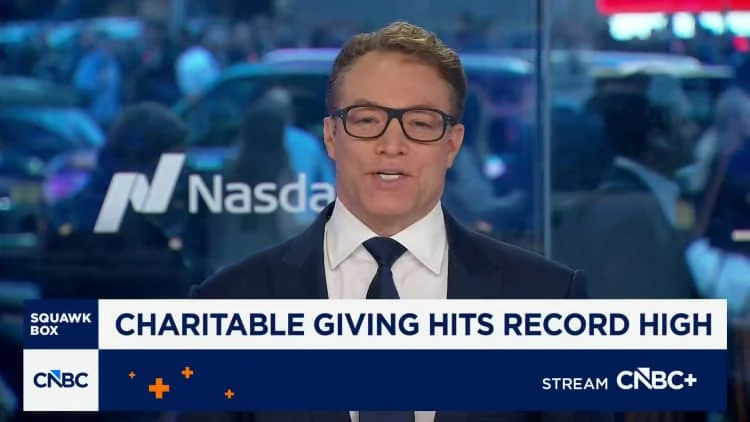
U.S. charitable giving tops $600 billion for the first time: stock-market boom and bequests
According to the Giving USA report, U.S. charitable giving last year was estimated at $617.2 billion, up 5.7% from the prior year. The increase came against the backdrop of a strong stock-market rebound.
This marks the first time in the 60-year history of the annual charity report that giving topped $600 billion. Adjusted for inflation, donations rose 3% year over year.
But the impact of the market boom was more pronounced among wealthy donors. Individual giving still accounted for the largest share at $394.2 billion, but after inflation adjustment it rose only 1.4%. Charitable bequests, by contrast, jumped 16.6% to an estimated $62.19 billion.
The rise in bequests may be the latest sign of the Great Wealth Transfer. Cerulli Associates expects more than $124 trillion in assets to change hands by 2048, of which about $18 trillion is expected to go to charity.
Jon Bergdoll, the report’s lead analyst, said it is still too early to tell how much of the increase in bequests is tied to this massive handoff of wealth.
What is clearer is that wealthy Americans, who are more likely to leave large gifts to charity, were among the main beneficiaries of the stock-market rally. Bergdoll noted a relatively close link between bequests and personal net worth, which is itself tied to markets.
At the same time, the stock market’s effect on broader total giving, including foundation and corporate giving, is slower and smaller. But Bergdoll said he expects stronger markets in recent years to eventually push total giving higher more noticeably.
According to the report, the inflation-adjusted S&P 500 rose 13.4% between 2024 and 2025, roughly four times the pace of total giving growth.
Bergdoll attributed the gap to a relatively muted macro backdrop: GDP growth was weak and consumer confidence was near historic lows. He said giving often comes from a sense of financial security, so that can weigh on donations at the individual level.
He also stressed that it would not be ideal if charitable giving tracked the stock market too closely, one-for-one. He would not want donations to fall by the same proportion when markets decline.
Tax incentives and reliance on the ultra-wealthy: shifting donation patterns
The report said many high-income donors are expected to “accelerate” giving in 2025 to take advantage of tax breaks that could fall after the passage of the One Big Beautiful Bill Act. Bergdoll said the increase is meaningful, but still limited relative to overall giving. The report estimated that donors gave an extra $1.71 billion in 2025 to make full use of expiring tax incentives.
Although U.S. charities are receiving more money, they are increasingly dependent on ultra-high-net-worth individuals as economic pressures squeeze middle-class donors. The report estimates that nine donors contributed a combined $22.32 billion to total philanthropic funding last year, with MacKenzie Scott, the philanthropist and former wife of Amazon founder Jeff Bezos, contributing the most at $6.65 billion.
These “mega gifts” — defined as at least 0.1% of total giving — can dramatically shift the charitable landscape from year to year. Nearly one-third of the increase in bequests came from the estate of the late Microsoft co-founder Paul Allen, who set up a $3.1 billion fund for science and technology research.
Two views on mega gifts and rising attention on heirs
Gabe Cooper, vice chair of the Giving USA Foundation, told CNBC he has mixed feelings. He said that when billionaires like Paul Allen and MacKenzie Scott commit large sums to charity, he welcomes it and hopes more billionaires will do the same.
But at the same time, he does not want the figures to grow too quickly, because dependence on the super-rich can make philanthropy more volatile from year to year. He said that if a billionaire dies and leaves $200 million to charity, the rest of the wealth will likely still go to children, so he hopes heirs make better decisions on charitable giving.
Beyond the benefit of rising bequests for charity, Cooper is focused on a longer-term issue: heirs and the charitable choices they make afterward.